Introduction to RCO
Regenerative Catalytic Oxidizer for short RCO, RCO is directly applied to the purification of organic
waste gas with medium and high concentration (1000mg/M3-8000MG/m3),the difference with RTO is that
there is a catalytic layer on top of the regenerative bed of RCO.
The regenerator chamber is filled with ceramic
regenerator and catalyst,and the catalytic combustion chamber
is equipped with a burner with proportional adjustment.
A total of pre-blowing, ignition, heating, incineration, thermal insulation, after blowing shutdown six states.
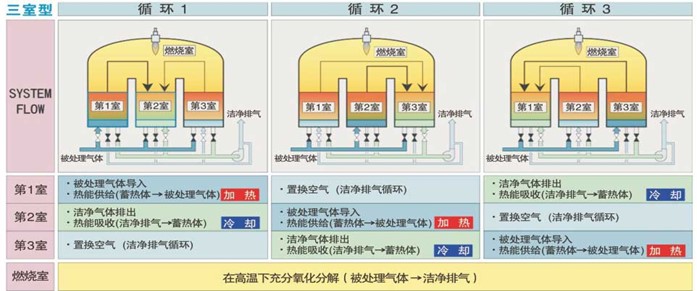
Workflow
1. In the industrial production process, the discharged organic tail gas enters the rotary valve of the equipment
through the induced draft fan,and the inlet gas and the outlet gas are completely separated through
the rotary valve.
2. After the gas preheated through the ceramic material layer1,the heat reserve and heat exchange
take place,and the temperature of the gas almost reaches the set temperature of the catalytic oxidation,
at which some pollutants are oxidized and decomposed.
3. The exhaust gas continues to heat up through the heating zone (either by electric heating or by natural gas heating)
and remains at the set temperature,and then enters the catalytic layer to complete the catalytic oxidation reaction,
that is, the reaction produces CO2 and H2O, and release a lot of heat to achieve the expected treatment effect.
4. The gas after catalytic oxidation enters into the ceramic material layer 2, and the heat energy is recovered
and discharged into the atmosphere through a rotary valve.
The exhaust temperature after purification is only slightly higher than that before treatment.
Continuous operation of the system, automatic switching.
Through the rotary valve work, all the ceramic packing layer are completed heating, cooling, purification
of the cycle steps, heat recovery.
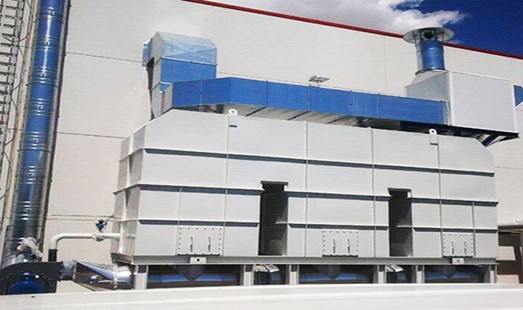
Equipment description:
1. RCO furnace body
The furnace body is composed of three regenerator chambers and an oxidation chamber.
The three regenerator chambers perform the functions of preheating,purging and heat storage respectively.
The shell is made of 6mm carbon steel plate (sand blast surface),with channel steel reinforcing bar on the outer surface,
the shell is well sealed, and the outer surface is coated with heat resistant paint.
2.RCO furnace body heat preservation
The furnace combustor and regenerator adopt refractory aluminum silicate fiber, heat-resistant 1200 ° C,
pile weight 192 kg/m3, thickness 250-300 mm.
A heat-resistant steel skeleton is arranged in the ceramic fiber module,and is fixed on the furnace shell by an anchor,
and the outer surface is coated with a high-temperature-resistant surface.
The furnace body surface temperature environmental temperature+ 25 degrees and not more than 60 degrees C.
3. Catalysts
The catalyst used in this scheme is an organic waste gas purification catalyst.
Pd, PT and so on are the main active components,which is a new and efficient organic waste gas
purification catalyst.
4.RCO combustion system
The system can be powered by an Eclipse,McKesson Maxon,and a North industrial gas burner.
NFPA standard, double shutoff valve design.
Diesel fuel, high-pressure ignition,can adapt to a variety of circumstances.
RCO treatment technology is suitable for high demand for heat recovery,but also suitable for the same
production line,due to different products,exhaust gas composition often changes or exhaust gas
concentration fluctuations of the occasion.
Application Industries including petroleum, chemical, rubber,paint and coatings,painting and spray,
shoe viscose, plastic products, metal can printing,printing ink,cable and enameled wire production
line waste gas treatment,the utility model is especially suitable for the waste gas treatment of the enterprise
or the drying line which needs the heat energy recovery, and can be used for the drying line to achieve the goal
of energy saving.
The types of organic matter that can be treated include benzene,ketones, esters, phenols, aldehydes,
alcohols, ethers and hydrocarbons.