Process flow and description:
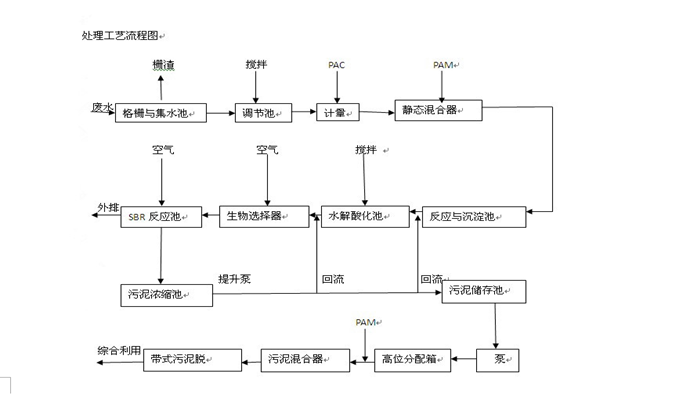
1 . Regulating pool
The regulating pool is mainly used to regulate the unevenness of the water quantity and quality of the incoming water.
The adjustment time is designed to be 8 hours.
2 . Reaction tank
The reaction tank adopts a 6-grid perforated cyclone reaction form,and the flow velocity at the orifice
decreases gradually from 1.0m/s to 0.15m/s in each grid.
The reaction time is about 20 minutes.
3 . Sedimentation tank
Adopt inclined plate sedimentation tank.The spacing between inclined plates is 80mm, and the surface hydraulic load
is 2.1m/ (㎡/h).
4 . Hydrolysis acidification tank
The hydrolysis acidification process is mainly used to break the ring and chain of benzene ring substances
and large organic molecules that are difficult to degrade,turning them into small molecule substances that
are easy to biodegrade.This improves the biodegradability of wastewater and is beneficial for subsequent
aerobic biodegradation.
The designed hydrolysis and acidification time for this project is 15 hours,and elastic packing and underwater aeration devices
are installed in the tank.
5 . Biological selector
A biological selector (also known as a reaction zone) is installed at the inlet end of the SBR reaction tank
to achieve sufficient mixing and adsorption of the organic matter in the reflux activated sludge and raw water,
allowing for the selection, cultivation,and domestication of a large number of microorganisms in the reflux,
inducing highly active microbial populations,and inhibiting the growth and reproduction of filamentous bacteria,
which plays an important role in controlling sludge expansion in subsequent aerobic reactions.
The reaction process usually takes 45-60 minutes to complete.
6 . SBR process
Also known as sequencing batch intermittent activated sludge process,it is a sewage biochemical treatment process
that has emerged in China in recent years,integrating functions such as biodegradation, sedimentation, drainage,
and sludge discharge.
During operation, a PLC programmable controller is used to achieve automatic control of the entire process based
on time and liquid level.
This project is equipped with three SBR reaction tanks, each with a 12 hour operating cycle.
The water filling period is 4 hours, the reaction period is 8 hours (including a water filling period of 3.5 hours),
the sedimentation period is 1.5 hours, the drainage period is 1.5 hours,the idle period is 0.5 hours, and the MLSS is 3500mg/L.
7 . Sludge treatment system
The sludge in this project is divided into two parts: chemical sludge and residual activated sludge.
The former is discharged through the initial sedimentation tank and directly enters the sludge dewatering system;
The latter is equipped with an 8m × 5m × 8m concentration tank in each SBR tank.
The concentrated sludge is pumped back to the biological selector and hydrolysis acidification tank through a lift pump,
and the remaining sludge is stored together with chemical sludge in the sludge tank for dewatering and external transportation.
Five belt press filters with a bandwidth of 2m are installed for sludge dewatering.
Operation effect of sewage engineering
After more than three months of effectiveness and monitoring,the treatment effect is significant
and the operation is stable.
The actual COD removal rate in the mixed precipitation process is 40%~50%,and the BOD removal rate is 30%~50%.
SS removal rate is 60%~70%; In the hydrolysis acidification process,the COD removal rate is 25%~35%, and
the BOD removal rate is 20%~25%.